- Home
- Other Sports
- Modern Cricket . . . The Biggest Niche Sport In The World

If you’re a general sports fan, the recent cricket T20 World Cup in India and Sri Lanka probably passed you by.
There was a time when sport on free-to-air television catered perfectly for the casual sports fan.
A bit of FA Cup romance in January; Ronnie Radford hitting one flush, top bins. Six Nations drama and the England rugby team dropping their shopping in February and March (which is nothing new).
April a bumper month; The Masters (Alliss), the Grand National (O’Sullivan), and snooker (Lowe) from the Crucible, the soundtrack to the spring.
Summer days, pale blinds drawn all day for tennis, golf and the cricket. Throw in intermittent Olympics, World Athletics, Commonwealth Games, Ryder Cups, Lions tours and World Cups, and the armchair fan was well serviced.
READ MORE: Welsh Rugby . . . A Love That Endures . . . Maybe
What place now for cricket, beyond the Ashes heroics of Ben Stokes, in the general sporting consciousness?
Most sports now exist in a digital paywalled niche, battling for eyeballs and looking on jealously at football’s cultural dominance.
A quick recap for the generalists (me included). Cricket is increasingly controlled by India.
Gone are the days of the admirals and colonels and chaps called Plum running the show at the MCC. India is now the powerhouse of the world game.
Cricket is the world’s second most popular sport, largely because India has a massive population and people who live in India love cricket.
This doesn’t necessarily result in greater reach and depth in global interest. Despite the emergence of nations like Nepal and Italy at the recent World Cup, it can feel like cricket is static at best, at worst contracting.
READ MORE: Big Bash, Bosh . . . Ashes Series Was all Vibes, Clips and Short (Leg) Attention Span
It is also a sport whose rules, schedules and priorities increasingly reflect political influence and commercial power, specifically that of India.
Over the last decade, the narrative of global cricket has been shaped by Indian administrators and broadcasters such as Star Sports and JioStar. Cricket is no longer governed by laws so much as hard cash.
The World Cup saw all kinds of shenanigans: not playing the last group games simultaneously, India’s semi-final venue being decided whatever the outcome of the groups, and fixing the draw so India met Pakistan, a fixture fraught with toxic complications. India’s psychodrama played out to a bemused audience.
India’s influence over franchise cricket largely stems from the financial power of its governing body and the global success of the IPL.
READ MORE: When Rory met SPOTY . . . and Joined Wales’ Pioneer, Dai Rees
The IPL attracts the world’s best players and huge broadcasting deals, meaning international schedules and player priorities revolve around it.
Indian franchise owners have also expanded overseas, purchasing teams in South Africa and soon in Australia.
There is influence in The Hundred, where several franchises now have Indian investment, extending India’s commercial and strategic reach across global cricket.
The recent Hundred auction hardly cut through to the sporting generalist.
The main headline: Abrar Ahmed bought by Sunrisers Leeds to quash concerns that Pakistan players would be ignored by franchises affiliated with the Indian Premier League, mirroring a ban that has been in place in India since 2009.
Mid-World Cup, it was reported by BBC Sport that Pakistan players may not be signed by the four Indian-owned franchises. It caused one almighty stir in the media.

Former England captain Michael Vaughan argued that the England and Wales Cricket Board must act quickly.
The ECB owns the competition, he said, and discrimination of that kind should not be allowed in what is supposedly one of the most inclusive sports in the country.
The ECB and the Hundred teams did move quickly, stating all teams are ‘committed to selection being based solely on performance’.
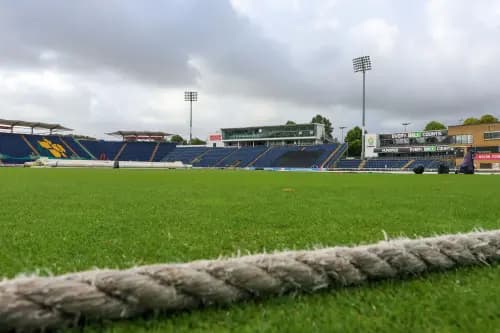
Around these parts, Majid Khan, Javed Miandad and Waqar Younis are embedded in cricket folklore. Hell, Waqar even had a ‘Waqar is a Welshman’ chant during Glamorgan’s ’97 Championship win!
Cricket is always better for the inclusion of Pakistan players, be that Imran and Wasim hooping it around corners, or Javed wrapping his bat around Dennis Lillee’s head.
They are box office. The IPL is, and cricket would’ve been cheapened at the prospect of their omission.
Moreover, the sport finds it increasingly difficult to manufacture an elite game which mirrors the community game in terms of representation and diversity.
Any thought of diminished Pakistan representation makes the job of the guardians of the community game even harder.
My guilty pleasure - I’m a fan of The Hundred, the concept more than its implementation (though this was hamstrung by Covid in 2020).
The injection of cash thanks to the introduction of (mostly Indian) private equity now gives the concept a second chance to reach new and general audiences. We’ll keep a watching brief.
Cricket has been in existential crisis ever since the ECB’s own data found more kids were aware of John Cena, than then England captain Alistair Cook.
The T20 World Cup final, like the Hundred auction, arrived and passed with little interest for anyone beyond the diehards.
The challenges for cricket to cut through in 2026 remain very real.