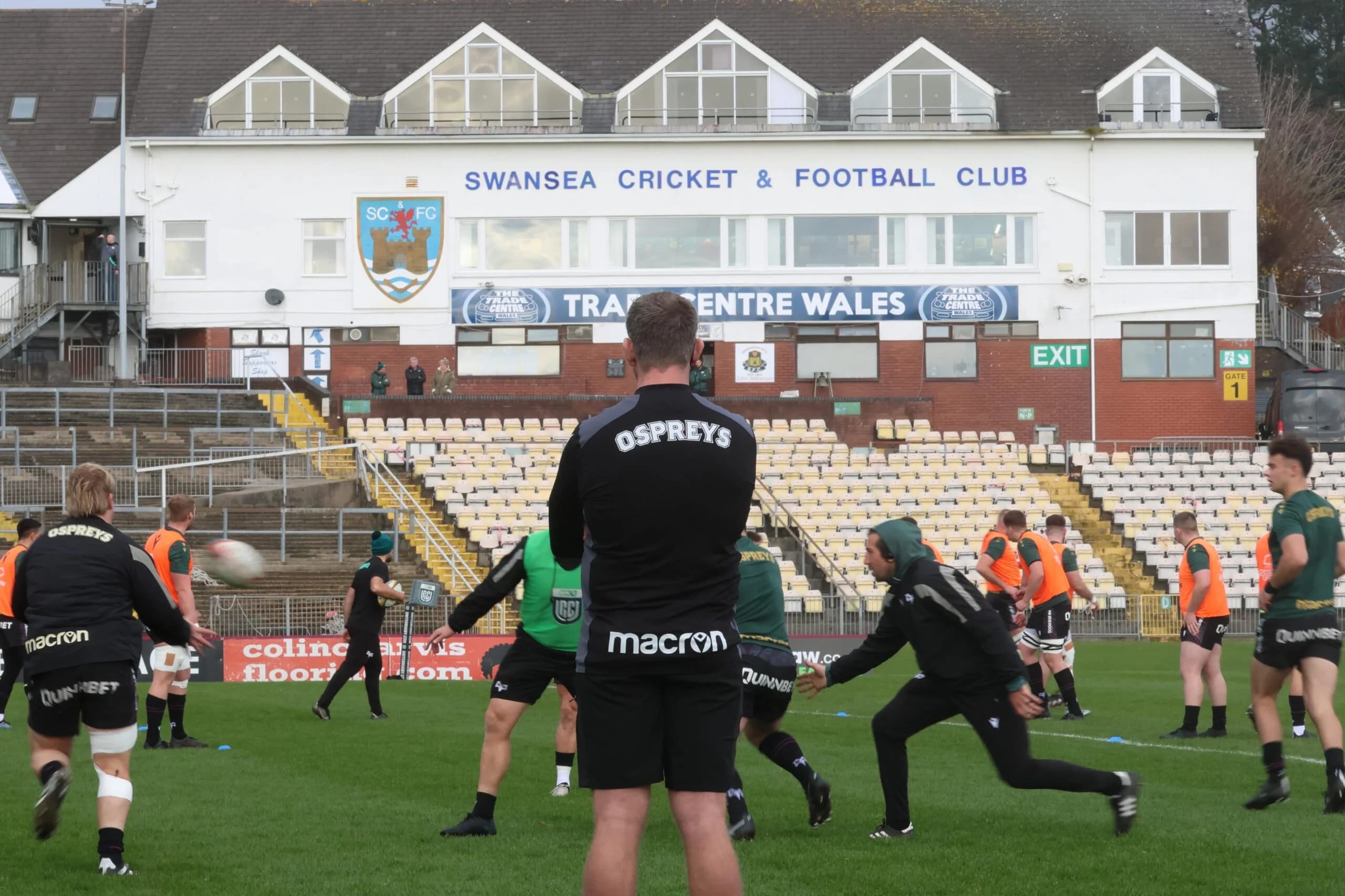
The Ospreys flew 18,000 miles in order to play two matches last week and all they got for their troubles was two defeats, 60 points conceded, and a bite on the hand for would-be lion-tamer Scott Baldwin. Peter Jackson wonders whether the regions may have missed a trick closer to home.
When the fledgling Ospreys first took flight in the Celtic League, they had no idea that it would come to this: a ten-day trek to Europe and Africa.
The tournament’s quantum leap from inter-provincial to inter-continental handed the former double champions a trip from Swansea to Bloemfontein via Treviso, from one non-Celtic region to another. New Frontierism isn’t always all it’s cracked up to be.
The Celts have been pushing the boundaries back as a matter of sheer economic necessity, forced to look at the bigger picture in a far-flung search for new streams of revenue. The irony of the expansionist policy from a Welsh perspective stems from a failure to cross the nearest boundary, the one over the Severn Bridge.
Almost 20 years ago, it would not have taken an oval-ball Einstein to see the blindingly obvious and put it into operation. An Anglo-Welsh League would have preserved some of the famous old fixtures.
The RFU kicked off by offering two Wales places. When the WRU told them what to do with their offer, they doubled it to four, not entirely for altruistic reasons but because their competition would be all the better for the best of the Welsh.
At a summit meeting in Worcester, the RFU offered Wales six places in a putative British League. The WRU insisted that all nine of their Premiership clubs had to be included.
Four of those nine – Bridgend, Caerphilly, Ebbw Vale, Pontypridd – were to be sacrificed on the altar of regional teams which meant shot-gun marriages under new names, Swansea-Neath as Ospreys, Bridgend-Pontypridd as Celtic Warriors. One survived, the other didn’t.
“The British League was a good idea,’’ Brian Baister, then RFU chairman, said. “Professional rugby was broken with a capital B, Scottish rugby in particular. I could see it vanishing if something wasn’t done and I saw a British League as a way of ensuring that didn’t happen.”
When the Welsh delegation stood by their demand for nine places on a take-it or leave-it basis, the RFU chose to leave it. Instead the Welsh joined forces with the Scots in what became the Celtic League.
“An Anglo-Welsh league is what England and Wales wanted,” Baister said. “But what would have happened to the Irish and Scottish clubs? To be honest, the Irish-Scottish-Welsh League was my worst nightmare. No promotion or relegation. You lose the first four matches and you’ve got nothing left to play for.”
So instead of Leicester and Northampton in a tour of the East Midlands, Ospreys are obliged to slog their way from northern Italy to the old Boer republic of the Orange Free State. New venues do not always equate to new crowds.
The South African dimension is worth £6m to the rest of the PRO12. Without that windfall, the Scarlets admit they could never have afforded to hire Leigh Halfpenny, not even at 40 per cent of his dual contract with the WRU. What they haven’t brought is a crowd, or at least not yet.
The same goes for the US. They have been talking up the notion of America being the next big rugby market for so long now that some of us have grown old waiting for it to happen.
Newcastle made more money out of switching their home match against Saracens from Tyneside to Philadelphia but when the stadium is two-thirds empty, what’s the point? Premier Rugby over-estimated public demand by expressing expectations of a full-house of 18,500.
Four years ago, Rugby Law, a company based in Minneapolis, banged the drum about a match between London Irish and a US Barbarians team at the New England Patriots stadium in Boston for the ‘Independence Cup’. They hoped for a crowd of 30,000, then abandoned the project due to general apathy.
As a London Irish official said: “The Americans perhaps jumped the gun a little bit.”
Then there was the time when Rupert Mudoch was supposedly on the verge of backing a national club championship encompassing a minimum of six US cities from sea to shining sea, New York to Los Angeles. A quarter of a century later, it is still to happen.
Peter Jackson’s column appears courtesy of The Rugby Paper.