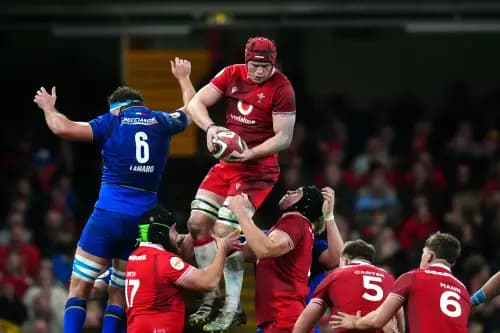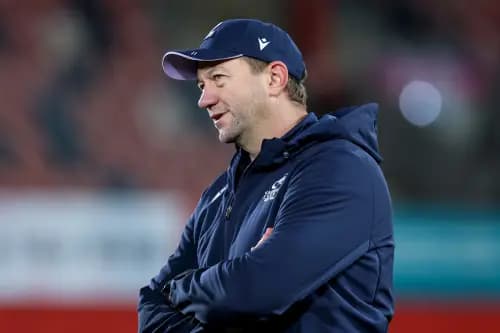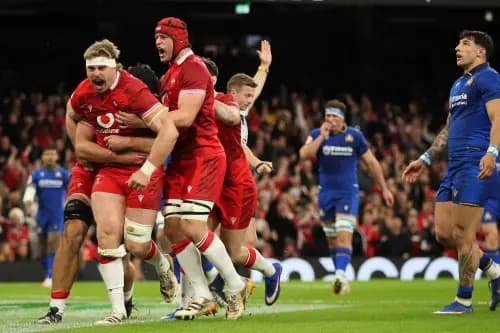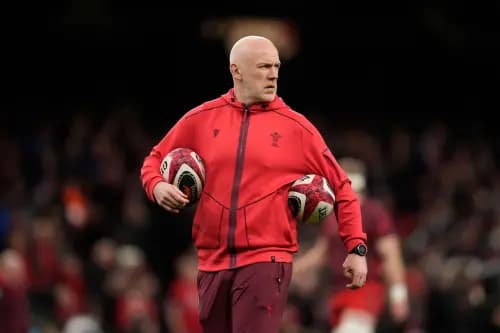

The Six Nations has come and gone, So, too, has the Welsh campaign in Europe. Wales fans are left only to speculate upon Lions selection, while hoping the Ospreys and Scarlets can cling in to the top four in the Guinness Pro12. Is Warren Gatland now part of the problem? Geraint Powell argues that Gatland is, in fact, still the solution.
When Welsh Rugby Union chief executive Martyn Phillips announced the intended last-ditch bail-out of the Newport Gwent Dragons, to save them and Newport RFC, it was pleasing to see him credit the input of Warren Gatland on the rugby side.
As a player, Gatland was a Mooloo (i.e. the Waikato province) and an All Blacks tourist. As a coach, notably of Connacht, Ireland, Wasps and the Waikato province (and as a technical adviser to the Chiefs region in Super Rugby) his experience is widespread. And then he became the Welsh national coach in time for the Six Nations in 2008. He knows the New Zealand, Irish and English, not merely the Welsh, rugby structures and systems from the inside – both the strengths and, especially in Wales, the weaknesses.
We all know big transformational change is finally coming to Welsh rugby. The Rugby Services Agreement was the last chance saloon for the old order, the last opportunity to demonstrate that the 2003 politics-driven fudge between conflicting global business models could ever work, for those resisting representative modernisation. We are now in the 22nd year of the professional era and the inefficient disjointed structures in place remain completely unfit for purpose.
Should anybody still not grasp this, another poor Welsh season in Europe came to an end in the quarter-finals of the secondary competition. The Cardiff Blues were thrashed 26-46 at lowly Gloucester (oh for the good old days, watching Pooler put 50+ points on Gloucester!), the Ospreys were inept against a 14-man Stade Francais. Meanwhile, across the Irish Channel, Munster and Leinster prepare for semi-final action in the Champions Cup. This is a Welsh problem, not a Pro12 problem.
Few coaches can have had such spiteful rubbish written about them as Gatland. Some in Wales seem to pretend that the 1990s never happened, when Wales shipped 0-51 points to France, 6-63 points to Australia, and 13-96 points to South Africa. And 8-71 to New South Wales, and don’t even mention Samoa (all, or just the western half).
As regards Gatland, former All Blacks 2011 World Cup-winning coach Graham Henry left Wales after 54 points were conceded in Dublin against Ireland in 2002. 2015 World Cup-winning and current All Blacks coach Steve Hansen never won a Six Nations match other than Italy/Scotland at home when he was Wales coach 2002-04. Mike Ruddock, despite the scintillating 2005 Grand Slam, was gone the following season following a 13-47 drubbing at Twickenham and open player-power rebellion. Gareth Jenkins followed in 2007 after the Wales team went tactically AWOL in a (thrilling) World Cup pool match and played (and ignominiously exited) 7s style rugby against Fiji.
Gatland’s record may be poor against Tri-Nations teams, but when was the Welsh record in the last 35 years against Australia not poor? And when was the Welsh record against South Africa ever anything but poor? As for New Zealand, Wales last beat them in 1953, when Winston Churchill was Prime Minister. That is the context.
Gatland’s northern hemisphere record has been considerably better – three Six Nations titles (if you include 2013 when Rob Howley was in temporary charge) including two Grand Slams and never less than two wins even in poorer campaigns. Wales, compared to certain other Test sides, have never been as good at stopping a classy opposition from playing their game. Instead, Wales have tended to focus on their own game.
The ultimate caricature is so-called “Warrenball”, but that is ridiculous stereotyping. A coach has to make the best use of his available raw materials. None of the teams he coached before Wales were based on a series of large ball carriers across 11-14.
His reputation was really built coaching Wasps to consecutive Premiership titles from 2003-2005 and to their Heineken Cup win in 2004. I only watched them live twice, both in the Heineken Cup, once against a Welsh region at High Wycombe and once at the final against Toulouse at Twickenham. Wasps played an all-round game, but it was their famed blitz defence that often caught out teams. An 11-14 of Tom Voyce, Stuart Abbott, Fraser Waters and Josh Lewsey were hardly ball-carrying giants from the current Welsh mould.
Like just about all professional era rugby coaches, Gatland will always select a “good big un” over a “good small un” to power us across the gain line and win the collisions. But the so-called “Warrenball” template (Taulupe Faletau “the carrier”, Dan Lydiate “the chopper”, Sam Warburton “the jackal”, George North/Jamie Roberts/Jonathan Davies/Alex Cuthbert the big hard running carriers) was, in reality, a product of circumstances.
People quickly forget Gatland’s first couple of years in Wales, when James Hook battled for the 10 jersey with Stephen Jones. When he lost that battle, Hook found himself playing at 13 in the 2010 Six Nations. He showed his attacking strengths (at Twickenham) and his defensive frailties (against Scotland in Cardiff). He did not completely fall out of first team favour until after his 2011 World Cup semi-final performance against France.
Gavin Henson, a physical player but also very much a sublime footballing second five-eighth, was the defensive captain in the 2008 Six Nations. It was clear that a Henson/Roberts centre partnership was intended for the 2009 Six Nations and that will forever remain one of the great “What if’s?” in Welsh rugby. If only Henson’s Test career had not imploded. And, of course, “twinkle toes” (little Shane Williams) was an ever-present until his retirement in 2011. The exciting Ashley Beck played two Tests out in Australia in 2012, before a horrendous catalogue of injuries removed him from the equation.
The pivotal moment, with hindsight, was the renewal of the contract with the regions in 2009. The annual WRU subsidy increased from £3.6 million to £6 million between 2009 and 2014, but the 66.67% increase proved insufficient in itself to defend against worsening external and internal market forces.
Spiralling TV revenues and wage inflation in France, supercharged by exchange rate movements, and a weak domestic economy in recession. This was followed in 2012 by the announced 2013 arrival in English domestic professional rugby of the BT Sport “money pit”, BT’s commercial response to Sky’s increasing penetration of their broadband market. Cue the open conflict between the financially stressed regions and the WRU from 2012.
Leading Welsh domestic coaches, such as Lyn Jones at the Ospreys and Nigel Davies at the Scarlets, had openly commented before Gatland’s arrival in 2008 on the tendency of many Welsh professional players to look to the coaching box for guidance and help when a game plan was struggling rather than to think themselves through to victory unaided. That issue became more acute as the regional supply chain deteriorated and players went into exile. Many argue that the academies have inadvertently built-up physicality at the expense of rugby intelligence and nous.
So it was inevitable when Wales suddenly had a new and limited supply of physical young players, rather than of footballing players, and especially of large powerful three-quarters, that Gatland increasingly built a limited, patterned game around their attributes at the collisions and gain lines and it delivered handsomely (at least at the hemisphere level). North and Cuthbert joined Roberts and Davies on the successful 2013 Lions tour to Australia.
So how will Gatland run at the World Cup in 2019? Much may depend on what he has learnt and decided over the course of his Lions sabbatical, including the titanic six weeks to come in New Zealand and not just the season-long opportunity to step back from the South Walian coastal “goldfish bowl” and to look at the big global picture. In terms of an opposing rugby coaching brains trusts, they don’t come any stronger than Hansen, Ian Foster, Wayne Smith and Grant Fox.
My gut instinct, looking at Gatland’s career, is that we are likely to see significant evolution next season. And I say that as somebody who has not always agreed with some of his decisions. I would certainly have liked to have seen some fresh faces in the coaching set-up after the last World Cup, much as Sir Alex Ferguson used to regularly change his assistants (seven) during his 26-year tenure at Old Trafford, but the choice is ultimately that of Gatland and, for whatever reason, he has preferred continuity.
If the assistant coaches have never even held a regional top job, in terms of succession planning, they cannot be realistic candidates to succeed Gatland in 2020 and another import (almost certainly a New Zealander) will be required.
Gatland has to work with what he has. For whatever reasons, and there are some very decided views from some very knowledgeable people, the regional academies are not producing front five forwards of calibre in the numbers or quality required. Wales U20s recently started a match without either starting lock coming from one of the four academies. Yet we are beginning to stockpile back row, which has proved very harsh on Thomas Young. But we can never have too much depth, anywhere.
The big question for Gatland is how to freshen up the attacking threat, without creating unacceptable defensive frailties. And the crux of the matter will be the pivotal 10/12 axis.
As a big fan of the strong footballing 12, with a big boot, I would certainly like to see Owen Williams get a run out at this level. A left/right playmaker option. The ghost of Henson, and what might have been, still looms large. I have always felt that the cash-strapped Scarlets made a big mistake in letting Williams go, even if keeping him might have meant releasing Rhys Priestland.
And then the flat-lying Sam Davies – will he get a run at 10? Dan Biggar stands deep, and is rapidly becoming a temperament liability with match officials. But Leigh Halfpenny is not the all-round player he was before his Toulon exile, and Biggar provides the world class goal kicking in the event of Liam Williams replacing Halfpenny at 15.
The question is not whether Gatland will increase the attacking firepower in the wider channels, for that is the general direction of travel at the moment across global Test rugby, but what new balance will he strike between increased wider attacking firepower and maintaining a degree of defensive solidity? And that is something we will all only find out over the next two-and-a-half years.