
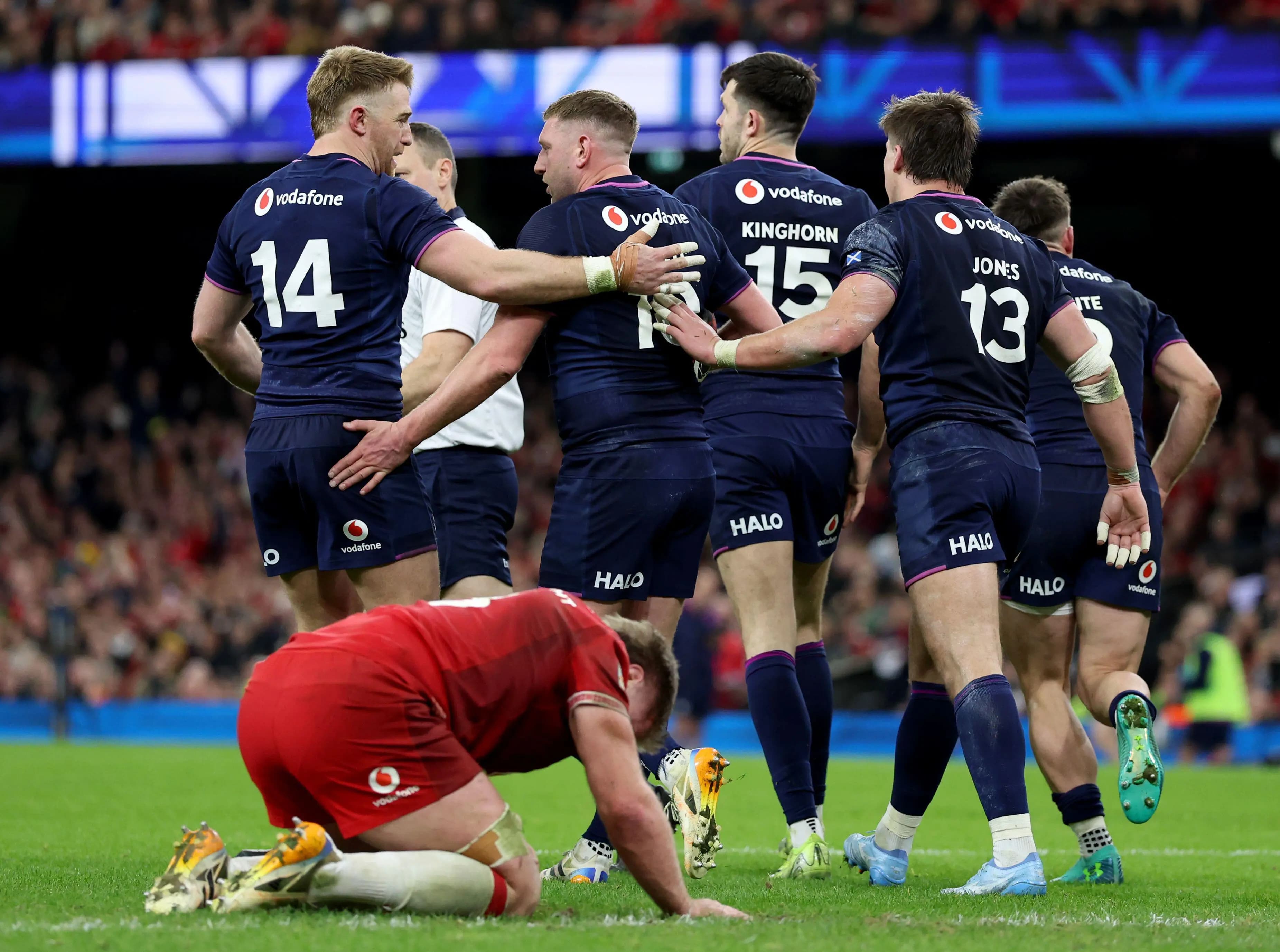

It may have been a 14th successive Six Nations defeat for Wales - 26-23 - it may have been a sixth defeat out of seven matches for the beleaguered Wales coach, and it may be three years and counting since Wales last won a match in the tournament, but within the narrow confines of his definition of progress, this was a seismic leap.
It was a good spectacle, too, in what is shaping up to be an exciting year for the Championship.
Tandy had said he was looking for progress from the defeats to England and France, for Wales to be competitive, but he whispered nothing about winning, let alone shouted it from the rooftops.
In the end, Wales were leading for almost the entire game, until Scotland finally got their noses in front with four minutes left.
It would have been easy enough to frame a Wales win as deserved, so long were they on top - even if they were eventually outscored by four tries to two.
Instead, the coaches and players will have little difficulty in talking about improvements and progress within yet another defeat - their 24th in their last 26 Tests.

After all, conceding four tries at home in defeat is only half as bad as conceding eight, which is what happened against the French.
That says a good deal about the state of things in Welsh rugby, that a fixture which used to be an almost routine home win is now a cause for optimism because the defeat wasn’t a heavy one.
The list of things which were much better, though, is long and both collective and individual.
Wales’ tackling - especially their first-up challenges - had much more authority, their set-piece was solid, and there was an energy with the ball in hand, especially from Dewi Lake, Rhys Carre and Aaron Wainwright.
Eddie James caused Scotland problems in the centre, whilst Sam Costelow - on his retuurn to the team at No.10 - showed maturity and tactical awareness.
When they attacked in the first half, Wales were slick, sharp and carried a punch - attributes they have not had for a long time.
In coach-speak, there was a lot to like.
Winning really mattered to Scotland. After beating England, they have so often been incapable of backing things up.
This time, they fumbled and fiddled their way through most of the game, but found sufficient composure to come from behind and win it late on.
Wales played their best rugby of this tournament - and maybe any Six Nations tournament since 2023 - in a first-half which ended with them leading 17-5.
They scored two tries - for Carre and Josh Adams - and played with a pace and intensity that was wholly lacking in their first two fixtures.
But they managed only six points in the second-half - through two penalties - and conceded three tries as Scotland finally found their accuracy.
The key moment came just before the hour mark when Scotand’s problems at the breakdown gave replacement Jarrod Evans the chance to land a penalty that took Wales’ lead up to 23-12.
From the re-start, Finn Russell showed his rare talent for seeing what others don’t notice.
Spotting Wales were slow to re-position on their right flank, the Scotland fly-half dropped his kick beyond a startled Gabriel Hamer-Webb and James Botham.
Darcy Graham motored past them both and after Russell nailed awkward conversion, Scotland were suddenly within four points, at 23-19.
That was the turning point as Scotland claimed a fourth straight win over Wales — their strongest sequence in this fixture since five on the bounce between 1923 and 1927 — and they now travel to Dublin on the final weekend with the Triple Crown still within reach.
Wales, stung by blistering starts from England and France in previous rounds, were intent on beginning with greater control.
Instead, they were down to 14 men inside five minutes. Joe Hawkins caught Gregor Brown with shoulder-to-head contact and was shown yellow. A bunker review brought no upgrade, but Wales had to weather the immediate storm.
Josh Adams produced a vital interception on his own line to deny Scotland an early score, and that moment proved pivotal.
Ten minutes in, Tomos Williams tapped quickly from a penalty and Wales built momentum through the forwards.
The surge ended with Carre crashing over for his second try in as many matches. Costelow converted, but the home side soon lost Taine Plumtree to a shoulder problem.
Scotland responded with intent.Sione Tuipulotu drove through the middle and Finn Russell released Blair Kinghorn to send over Steyn in the corner moments before Hawkins returned to the fray.
Yet this was a more assertive Wales than in earlier defeats. Dewi Lake, scrambling on the turf at one stage, made telling metres as the hosts hammered away again.
Costelow held his nerve to release Adams for a wide score, then nailed the touchline conversion and followed up with a simple penalty as Wales dominated the collisions.
Another Costelow three-pointer pushed the advantage beyond two scores. Scotland’s irritation was summed up when Huw Jones, a double scorer against England, spilled the ball with the whitewash beckoning.
But Russell would not be denied. After more than 20 phases camped on the Welsh line, the fly-half spotted a gap, darted through and converted his own try to swing momentum.
Jarrod Evans, on as a replacement, immediately added a penalty to steady Wales. The response was instant. From the restart, Russell launched a high ball over Botham, and Graham reacted quickest to gather and score. Russell’s conversion narrowed the margin to 23-19.
Wales thought they had breathing room when awarded a penalty, only for it to be reversed for foul play. That reprieve proved decisive.
With five minutes remaining, substitute hooker Turner forced his way over for Scotland’s bonus-point try, and Russell applied the finishing touch.
Another defeat for Wales, but far from their worst.