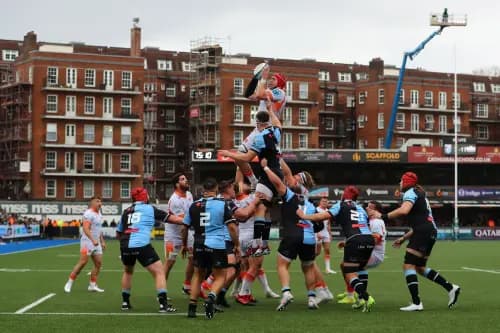

Coaches leaving the Cardiff Blues is nothing new in recent years, but the decision of Danny Wilson to quit next spring symbolises so much that has gone rapidly downhill, argues Rob Cole. From the chairman to the squad, to the commercial department, there is a need for overhaul.
There are many ways to look at Danny Wilson deciding enough is enough as the head coach at Cardiff Blues.
You could say he is leaving because he has potentially got a better offer to join a really big club in England, Northampton Saints, albeit in a less senior role.
On the other hand, you might say that his time is likely to be up sooner rather than later at the Arms Park club given the alarming rate at which they have parted company with their coaches in recent seasons.
But the most logical conclusion is that he is simply fed up of being promised the earth and being given nothing.
Having trimmed his squad to save money to invest in a few better players, Nick Williams being the best example, he was then initially told he had to trim up to £1m off his budget for the next season.
The financial climate then changed and he saw his chairman battling to bring Leigh Halfpenny back to the club. Unsurprisingly, he failed and the Wales full back went west.
The unseemly situation with the South African lock Franco van der Merwe was, perhaps, the lowest point for Wilson in recent months. Having identified a need for a second row enforcer he was delighted to have recruited him from Ulster on a two-year deal.
In the end, he never played a game for the Blues because they had to go back to his agent and tell him they couldn’t afford him. They paid his wages until he got clearance to play for London Irish in the Aviva Premiership, but what sort of message did that send out about the Blues’ seemingly parlous state?
Over the course of the professional era, the Blues had one coach for the first eight seasons in Dai Young. He won the Anglo Welsh Cup, the European Challenge Cup and took his team to the semi-finals of the Heineken Cup, where they were beaten by Leicester Tigers in a penalty shoot-out.
There was at least something – plenty, even – to shout about. Since then the statistics tell the whole story – six different coaches in seven seasons, four of them in caretaker roles, and a 10% drop-off in the success rate of the team in European and domestic league rugby.
Throw in the Anglo-Welsh Cup and it simply gets worse and you have to take into account that the last three seasons have been spent beating up semi-pro Italian and thoroughly disinterested French clubs in the second tier of European competition.
Coach Era P W D L Win%
Dai Young 2003-2001
League 158 86 4 68 54.43
Europe 54 29 1 24 53.70
A-W 24 14 1 9 58.33
Total 236 129 6 101 54.66
Others 2011-current
League 136 56 3 77 41.17
Europe 38 22 0 16 57.89
A-W 20 8 0 12 40
Total 194 86 3 105 44.32
As the old adage states, “if things don’t change, they will just stay the same”.
Wilson obviously saw that and decided to do the honourable thing and try to pursue his career in a more positive and stable rugby environment.
At least he will leave with his head held reasonably high, his reputation fairly untarnished and without the same stamp of failure with which his predecessors – Phil Davies, Mark Hammett, Gareth Baber, Justin Burnell, Paul John and Dale McIntosh – were forced to leave.
The problem at the Arms Park is that a failing team is supported by a fragile, struggling business that is run by a chairman whose main focus seems to be to want to build on the current ground to recoup the losses he has made over the past 20 years.
While Peter Thomas is still at the helm Cardiff Blues seems destined to either go the same way as the Dragons, and end up in WRU ownership, or fall further and further down the pecking order of professional rugby teams.
Rumours of a further cut in playing budgets for next season – 20 or more players come out of contract at the end of this season – must have played a part in Wilson’s decision not to sign a contract extension.
What sort of exodus will it bring about next season and who will the new head coach be able to attract?
A new commercial manager starts next week. Rhys Blumberg returns to the Arms Park as Rhys Williams heads in a different direction.
A big task awaits him, given the crowds for the first two home games were 1,312 down on the previous season and ticket prices have risen.
The Blues board may point their finger at the Guinness PRO14, WRU and TV companies for a lack of funding, but their financial plight is largely of their own making. Rugby used to be a playground for millionaires, now it is the preserve of the billionaires.
They are few and far between in Wales and, as is so often demonstrated in professional sport, the richest men and women don’t always make the same decisions in a sporting board room as they do at their own businesses.
It is difficult to predict anything other than more pain for the Blues and their supporters, who are being asked to pay more and more to watch a team that lacks quality, strength in depth and real identity. And while the team plays on the most modern of plastic pitches, the surroundings are almost 50 years old.
The Arms Park used to be a hostile place for teams to come and play. Now, it is just a tired, uninspiring and inhospitable venue. No wonder all the action, and fans, are now centred on Cardiff City Stadium where Neil Warnock has got a low budget side to play winning football.
Where will the Blues be if Warnock leads the Bluebirds back to the Premier League?
Let’s just hope the Blues don’t take down Cardiff RFC in the same way that Newport have suffered through the demise of the Dragons.